Kathmandu, 18 August: According to a fact-finding team comprising leaders of regional political parties allied with the government led by Indian Prime Minister Narendra Modi, China has prevented Indian troops from accessing some important patrol points in Arunachal Pradesh and has encroached on Indian territory.
The report by the fact-finding team has triggered political outrage in New Delhi. Opposition parties have criticized Modi, accusing him of remaining silent over alleged Chinese encroachments in various parts of the border in recent years.
New Dispute in Upper Subansiri
The newly collected information concerns the remote and mountainous Upper Subansiri district of Arunachal Pradesh. The report comes at a time when India and China, which fought a war in 1962, are attempting to improve bilateral relations and could once again increase tensions between the two countries.
The development comes as both New Delhi and Beijing face pressure from the trade war initiated by US President Donald Trump. It also emerges just weeks before Chinese President Xi Jinping is expected to visit India for the BRICS summit, which India is scheduled to host on September 12–13.
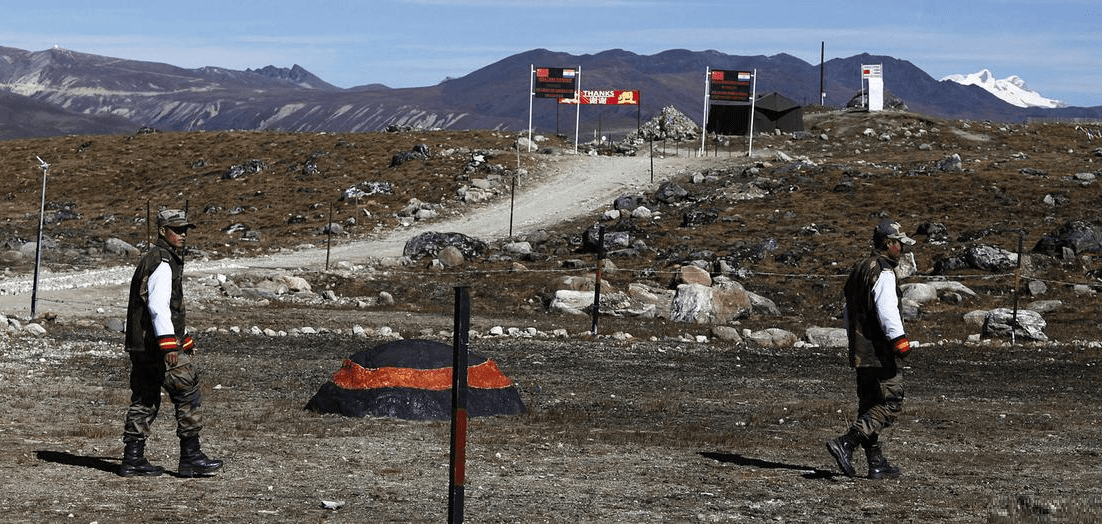
India and China share a 3,488-kilometer-long border stretching across Jammu and Kashmir, Ladakh, Sikkim and Arunachal Pradesh in northern and eastern India. Much of the border remains disputed. The two countries also have differing perceptions of the Line of Actual Control (LAC).
What Did the Fact-Finding Team Discover?
Kaling Jerang, vice-president of the People’s Party of Arunachal Pradesh (PPA), said the party sent a four-member fact-finding team to the remote area after initial reports of Chinese encroachment emerged.
The PPA is part of the North East Democratic Alliance, a regional coalition led by the Bharatiya Janata Party (BJP). The BJP also leads the government in Arunachal Pradesh.
According to the team’s findings after visiting the area, Indian security forces are unable to patrol the Taksing area of the state from April to October because of adverse weather conditions. During this period, the region faces the risk of devastating floods, monsoon and pre-monsoon rains, and landslides.
However, according to the report, Chinese troops remain active in the border area throughout this period. This has raised questions about whether India has sufficient infrastructure in place to enable its military to defend the border in the event of a possible Chinese attack.
Jerang’s report says local residents told the team that the Indian Army abandoned a border patrol point known as Shera-5 following a confrontation with the Chinese People’s Liberation Army (PLA) in 2023.
Jerang said local residents are angry about losing their ancestral hunting grounds. According to him, “the field reports regarding these incursions are difficult to refute.”
“These incursions are neither new nor sudden; rather, they have gradually expanded over the years,” he said. “But the BJP governments in both New Delhi and the state have turned a blind eye to the problems faced by people living along the border.”
Last month, the local tribal organization 88Nah Welfare Society (NWS)88 also wrote to government officials, claiming that Chinese encroachment had “increased manifold with the objective of occupying as much territory as possible.”
How Have India and China Responded?
The Indian Army has described media reports alleging Chinese encroachment as “incorrect and baseless.”
Since gaining independence in 1947, India has regarded the McMahon Line as its border with China. However, China, after establishing communist rule in 1949, does not recognize the line as the boundary between the two countries. Beijing argues that China did not participate in the negotiations at the Simla Convention.
India’s Ministry of External Affairs, however, has not dismissed the reports as categorically. Foreign Ministry spokesperson Randhir Jaiswal told reporters that India has consistently regarded border-related issues as “extremely serious” in its discussions with China and that maintaining peace and stability in the border areas is of utmost importance.
He added, “We have also made it clear that the situation along the border will have an impact on the overall state of our bilateral relationship.”
Beijing has also responded cautiously. China has apparently neither confirmed nor denied the reports of new tensions along the border. Chinese Foreign Ministry spokesperson Guo Jiakun said, “At present, the China-India border situation is generally stable.”
He said the two countries had held the 36th meeting on China-India border affairs the previous week.
“Both sides agreed to maintain communication through diplomatic and military channels and jointly safeguard peace and stability in the border areas,” he said.
Is There a Border Dispute Between India and China?
Yes. And the dispute lies at the heart of broader differences between the two countries. As with many border disputes in South Asia, the historical roots of the India-China dispute are also linked to British colonial rule.
In 1914, British India and Tibet, which was not under Chinese control at the time, determined their boundary at the Simla Convention and established the McMahon Line. Henry McMahon, then foreign secretary of British India, was the principal negotiator of the agreement.
Since gaining independence in 1947, India has regarded the McMahon Line as its border with China. However, China, which established communist rule in 1949, does not recognize the line as its boundary with India. Beijing argues that China was not a participant in the negotiations at the Simla Convention.
China claims the entirety of Arunachal Pradesh, referring to it as “South Tibet” or “Zangnan.” China also controls Aksai Chin, a disputed region of Kashmir claimed in its entirety by both India and Pakistan.
In 1962, India and China agreed to treat the Line of Actual Control (LAC) as the de facto boundary until their broader border dispute could be resolved, reflecting the territories actually controlled by each side.
However, according to B.R. Deepak, a professor of Chinese studies at Jawaharlal Nehru University in New Delhi, the two countries have not even been able to agree on where the LAC runs.
Because the two sides interpret the location of the LAC differently, patrols from one side often enter areas claimed by the other.
Tensions from Ladakh to Doklam
In mountainous Ladakh, located in the western sector of the LAC, India and China have experienced repeated face-offs and rising tensions in recent years. In June 2020, Indian and Chinese troops engaged in a physical confrontation that resulted in the deaths of at least 20 Indian and four Chinese soldiers.
Tensions have also continued in the eastern sector, which includes Sikkim and Arunachal Pradesh on the Indian side. Indian and Chinese troops clashed in the Naku La area of Sikkim in May 2020 and again in January 2021.
In the central sector of the LAC, India and China have relatively smaller border disputes in Barahoti in Uttarakhand and Shipki La in Himachal Pradesh.
Tensions also escalated in Doklam, a tri-junction between India, China and Bhutan, in 2017. After China sent large road-construction equipment to extend a military road southward, Indian and Chinese troops remained in a tense face-off for 73 days.
Professor Deepak of JNU said, “There is always a possibility that these issues could escalate further. Even a small untoward incident could trigger major tensions, as happened in Galwan.” He was referring to the clash in Ladakh in June 2020.
According to Praveen Donthi, a senior analyst at the International Crisis Group in Brussels, US tariffs imposed by the Trump administration have pushed India and China toward improving bilateral relations. However, the two countries are still in the process of “carefully rebuilding ties” after their recent border tensions.
“China uses the border dispute as a means of applying pressure and, as in the past, sends mixed signals. This leaves India uncertain about whether local military commanders are acting on their own initiative or on instructions from the military leadership,” he said.
What Are India and China’s Trade Relations Like?
Despite continuing tensions over the border, bilateral trade between India and China has increased significantly over the past decade.
According to the Indian Embassy in Beijing, bilateral merchandise trade between the two countries reached $151.1 billion in the 2025–26 financial year, more than double the $71.45 billion recorded in 2016–17.
The increase has been driven largely by Indian imports from China. India’s imports from China rose from $61.28 billion in 2016–17 to $131.63 billion in 2025–26. During the same period, India’s exports to China increased from $10.17 billion to $19.47 billion.
Meanwhile, the Trump administration in Washington has recently identified India as a “Tier 1” country. The US administration has accused India of being part of a 88“shadow transshipment network”88 that helps China evade US sanctions and tariffs.
According to Saheli Chatterjee, an assistant professor specializing in China-related affairs at Somaiya Vidyavihar University in Mumbai, the improvement in diplomatic and trade relations despite the border dispute is a key feature of India-China relations.
“Economic and diplomatic relations can improve without resolving the underlying strategic disputes,” she said. “The border is not simply an isolated problem between the two countries. It is more appropriate to understand India-China relations as ‘managed competition’ rather than genuine normalization.”
According to her, “China’s behavior can be understood as an attempt to maintain an imbalance of power along the disputed border. At the same time, it is also intended to send India the message that improvements in bilateral relations do not necessarily alter the fundamental strategic balance of power.”
Donthi agrees.
According to him, in the broader geopolitical equation, “India and China are destined to remain competitors.”
“As long as it remains unresolved, the unsettled border dispute will continue to haunt relations between the two countries,” he added.