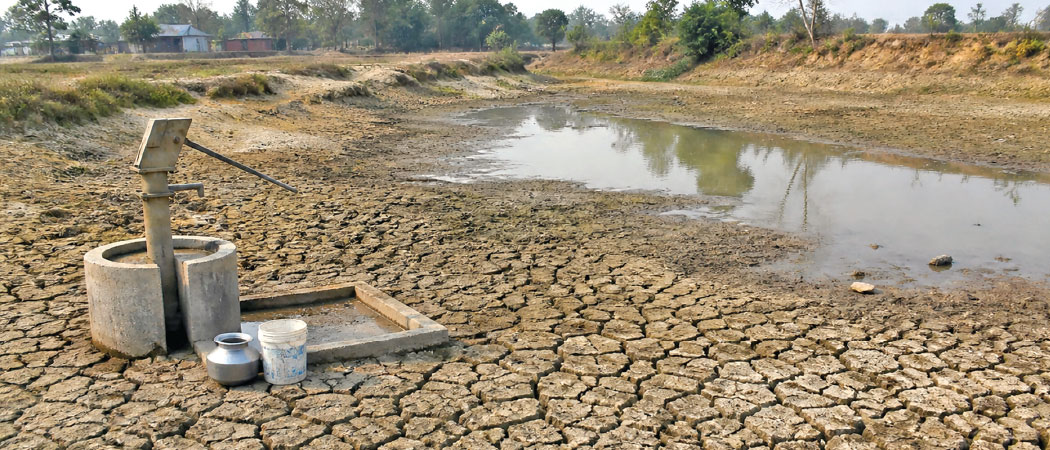
Kathmandu, 2 May: A parliamentary committee study has shown that climate change, changes in land use, and the destruction of the Chure–Bhabar region have triggered a water crisis in Madhesh. The study conducted by the National Assembly’s Development, Economic Affairs, and Good Governance Committee found that deforestation and uncontrolled extraction of sand and gravel in the Chure-Bhabar recharge zone have severely damaged the natural system responsible for replenishing water resources in Madhesh. As a result, base flow has weakened, worsening water scarcity across the region.
The study revealed that groundwater levels in Madhesh Province are declining annually by 2 to 4 meters. Long-term trends indicate a yearly drop of about 0.05 to 0.10 meters. According to the report, around 60% of tube wells in the province have water levels below the suction limit, and groundwater storage has decreased by an estimated 3,675 million cubic meters.
The report states, “Rainfall during last year’s monsoon was about one-third below average. The drought in Madhesh is not just a short-term weather event but a result of systemic imbalance between recharge and discharge.” Approximately 6.1 million people have been directly or indirectly affected by the water crisis in the region.
The summary of the report was presented in a meeting of the Development, Economic Affairs, and Good Governance Committee on Thursday. Committee Chair Krishna Prasad Paudel said that discussions would be held with experts and concerned stakeholders regarding the findings, recommendations, and suggestions of the report, and necessary directives would be given to the government.
Solutions to the Crisis
The study points out that in 1982, the groundwater status in eight districts of Madhesh Province was overall positive, but has significantly declined since then. About 45 years ago, 2,043 million cubic meters of water were extracted while 3,366 million cubic meters were recharged. The Bhabar region used to store the highest amount of rainwater, but its capacity has decreased due to excavation and deforestation. The Bhabar region used to store about 33.6% of total rainfall.
Recommendations of the Study
The parliamentary committee’s report, prepared when the water crisis in Madhesh peaked last year, outlines short-term, medium-term, and long-term policy actions. For the short term, it recommends immediate relief and recovery measures. For the medium term, it suggests widespread implementation of rainwater harvesting and artificial recharge projects. It also recommends constructing model recharge ponds in each municipality at high risk of drought before the next monsoon to increase groundwater infiltration.
During the last week of June (Asar) last year, major cities in Madhesh Province such as Birgunj, Janakpur, and Jaleshwar faced severe shortages of drinking water. Tube wells stopped producing water, and motor pumps failed to draw water, creating an acute crisis. In Birgunj, the provincial government distributed drinking water through fire engines to cope with the shortage. Following this, a subcommittee under the Development, Economic Affairs, and Good Governance Committee was deployed to study drinking water, sanitation, and hygiene in Madhesh. The parliamentary study, conducted with the support of the United Nations Office for Project Services, recommends protecting and conserving recharge areas for long-term solutions, banning uncontrolled extraction of riverbed materials, and legally safeguarding the Bhabar region.
It also suggests implementing formal licensing and metering systems for large industrial and agricultural water users, and transitioning from weak shallow groundwater sources to treated piped systems based on deeper aquifers.
The study surveyed 41 tube wells to measure groundwater levels. These wells were located north of the East-West Highway, in central Terai, and in southern Terai. Water levels were measured using contact sounders or deep tapes. In fiscal year 2020/21, drinking water projects funded through conditional grants from the federal government were handed over to the provincial government. Out of 436 drinking water projects received by Madhesh Province, 149 are still incomplete.