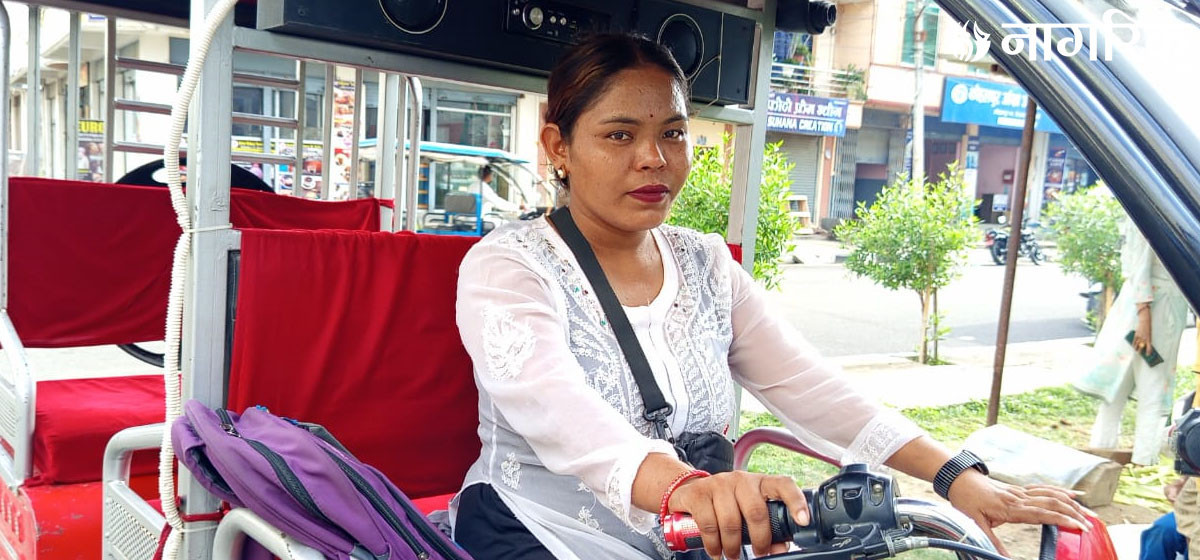
Kohalpur 28 June: It’s 7 a.m. in Kohalpur Bazaar. The town is already bustling. Tempos, auto-rickshaws, motorcycles, bicycles, and crowds of people fill the streets. Amid this hustle, a red auto slowly moves forward. At the steering wheel is Apsara Mahat—one hand on the gear, the other adjusting the speed of her e-rickshaw.
Her journey is not just about driving; it’s about keeping a dream alive. A dream of becoming self-reliant through education. A dream of breaking free from the cycle of physical disability and poverty. A dream of earning respect not just for being a woman, but for being capable.
Apsara, who never gave up, applied for jobs at dozens of places. She submitted applications to schools and small organizations. But no opportunities came her way based on her education.
Eventually, she says, “I let go of the illusion that education alone disqualifies you from doing small jobs. I put my certificates away in a box and decided to start driving.”
For the first four years, she drove a rented rickshaw—from 6 a.m. to 6 p.m.—enduring dust, heat, rain, and traffic. From the income she earned, she eventually bought her own rickshaw. That was the first step in her journey of achievement.
She visited small NGOs and skill-training centers in search of work. Some turned her away citing her physical condition; others simply said there were no opportunities. This exposed a harsh reality—that even an educated person with a disability often finds employment doors closed.
After many attempts and repeated rejection, she began to feel, “Maybe my dreams, like my certificates, are meant to be locked away in a box.”
Just as she described, one night she carefully wrapped her certificates in plastic and placed them in a box. That same night, she made a new decision—one that would change the course of her life.
One thought kept echoing in her mind: “As long as I keep moving forward, something is always possible—even if life tries to confine me.”
“With that courage,” she said, “I began a new journey—driving a rickshaw.”
The first time she gripped the rickshaw’s steering wheel, a swirl of emotions rushed through her—fear, hesitation, uncertainty. But above all, she says, was the courage to live with dignity.
“I used to be scared even to shift gears,” she recalls. “It was hard to face the stares from people on the street.”
But over time, circumstances hardened her resolve. From 6 a.m. to 6 p.m., she drove through the alleys, markets, and squares of Kohalpur, braving the heat, rain, and dust.
Sometimes, passengers mocked her, saying, “You’re educated—yet you’re driving a rickshaw?” But she brushed off such comments like unanswered questions—not worth a reply.
For four years, she drove a rented rickshaw.
Driving 8 to 10 hours a day, she lived modestly—wearing inexpensive clothes and eating simple meals—to save every possible rupee. Slowly, she began to build up her savings. And during those tough times, she grew stronger from within. Her strength eventually took shape in the form of something symbolic: her very own rickshaw.
“When I was finally able to buy a vehicle in my own name, I felt—this is how I’m putting my education to use,” she says. Holding the steering wheel of that rickshaw, she realized that her studies had given her courage and the clarity to make bold decisions.
Not getting a job didn’t mean her education had gone to waste—instead, it inspired her to pursue dignified labor. But even that rickshaw didn’t last forever. It broke down, and she couldn’t afford the repairs.
Now she’s back to driving a rented auto—but there’s a difference: she no longer feels afraid, ashamed, or helpless.
There’s confidence on her face—one that reflects a relentless effort to turn life’s defeats into victories. Her certificates still remain tucked away in a box, but they’re no longer a source of shame. They are not forgotten amidst the crowd of passengers; they stand as silent witnesses to a living journey toward a dream.
Today, she earns up to fifteen hundred rupees a day. She proudly says it’s the result of her honesty and hard work.
Apsara was born in 2054 B.S. (1997 A.D.) in Jajarkot. Her family lived a modest life. At just eight years old, a devastating accident changed the course of her life. While visiting Nepalgunj for her mother Laxmi’s medical treatment, they were involved in a road accident.
In the accident, Apsara suffered the most severe blow—her left leg had to be amputated. “Even today, my body trembles when I recall that day,” she says. “At the time, I thought I’d never be able to do anything again.”
But that very tragedy became the foundation for understanding life and learning to fight through hardship.
Apsara completed her SEE in Jajarkot and passed Grade 12 two years ago. She was always a top-performing student. “I used to dream of landing a government job and improving my family’s situation,” she says.
But the obstacles were towering—physical disability, financial hardship, and social pressure. She wanted to prepare for the civil service exams, but money stood in the way. Throughout it all, her brother Tek Bahadur Mahat has remained by her side, offering unwavering support.
After losing her leg, Apsara now uses a prosthetic one—but she says it’s her inner strength that truly supports her.
“My courage is far more reliable than my artificial leg,” she says with a smile. While driving, some people are visibly surprised to see her. Occasionally, passengers ask, “Why did you choose this job?” At such times, she replies, “I have an education, but no job. To survive, I have to work. No work is too big or too small.”
Apsara is now married and has a son. Her husband also works as a laborer. In Kohalpur, female drivers are still rare—but Apsara stands out as a powerful example among them.
“When you’re educated but still denied opportunities, you’re forced to choose alternatives,” she says. But Apsara didn’t let herself be confined by those alternatives—she rose above them, becoming a symbol of strength and empowerment.