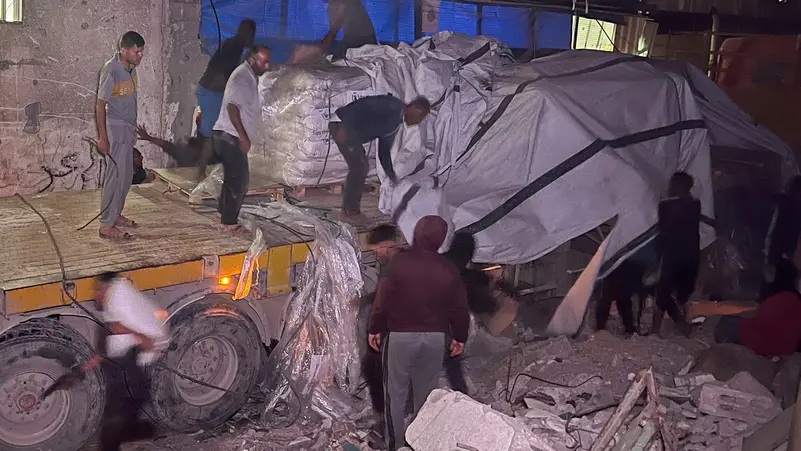
The United Nations said Wednesday it had dispatched around 90 trucks carrying aid into Gaza, as international pressure mounted over Israel’s renewed offensive and blockade of the war-ravaged Palestinian territory.
The first aid deliveries in Gaza since early March came as Israeli Prime Minister Benjamin Netanyahu said he was open to a “temporary ceasefire,” but reaffirmed that the military aims to bring the entire territory under its control.
Three days after Israel announced it would allow limited humanitarian access, the UN “collected around 90 truckloads of goods from the Kerem Shalom crossing and dispatched them into Gaza,” said UN spokesperson Stéphane Dujarric.
The development followed an incident earlier in the day in which Israeli troops fired what the military described as “warning shots” near a delegation of foreign diplomats visiting the occupied West Bank—prompting global condemnation.
In Gaza, the media office reported the arrival of 87 aid trucks, allocated to international and local organisations to meet “urgent humanitarian needs.” Netanyahu said allowing aid was necessary to “avoid a humanitarian crisis in order to preserve our freedom of operational action” in Gaza.
After weeks of near-total isolation, Palestinians have been scrambling for basic supplies amid critical shortages of food and medicine. Despite the aid entry, Israel has continued its bombardment. Gaza’s health ministry reported that 82 bodies had been brought to hospitals across the territory in the previous 24 hours.
‘Barely’ one daily meal
Umm Talal al-Masri, 53, a displaced Palestinian in Gaza City, described the situation as “unbearable.”
“No one is distributing anything to us. Everyone is waiting for aid, but we haven’t received anything,” she said. “We barely manage to prepare one meal a day.” Humanitarian groups have warned that the aid now entering Gaza falls far short of what is needed to address the crisis.
A US-backed private group, the Gaza Humanitarian Foundation (GHF), said it would begin moving aid into the territory in the coming days using contractors. Traditional aid organisations and the UN have distanced themselves from GHF, with some accusing it of collaborating with Israel.
GHF claims it will distribute some 300 million meals within its first 90 days of operation. Israel intensified its offensive over the weekend, vowing to eliminate Gaza’s Hamas rulers, whose October 7, 2023, attack on Israel triggered the war.
Amid rising civilian casualties and deepening humanitarian concerns, Israel has faced growing international pressure—including from its allies—to scale back its operations and allow more aid into Gaza.
On Tuesday, European Union foreign ministers agreed to review the bloc’s cooperation agreement with Israel, which includes trade relations. Israel’s foreign ministry condemned the EU move, saying it “reflects a total misunderstanding of the complex reality Israel is facing.”
Sweden has said it will push for EU sanctions on Israeli ministers, while the UK suspended free-trade negotiations with Israel and summoned the Israeli ambassador. Pope Leo XIV called the situation in Gaza “worrying and painful” and urged the entry of “sufficient humanitarian aid.”
Germany, however, defended the EU-Israel cooperation accord as “an important forum that we must use in order to discuss critical questions.” Israel resumed operations across Gaza on March 18, ending a two-month ceasefire.
Hamas’s October 2023 attack killed 1,218 people in Israel, mostly civilians, according to an AFP tally based on official figures. Militants also took 251 hostages; 57 remain in Gaza, including 34 the military believes are dead.
Netanyahu said Israel would be ready for a “temporary ceasefire to free hostages,” noting that at least 20 captives are still thought to be alive. Gaza’s health ministry reported that at least 3,509 people have been killed since March 18, bringing the war’s total death toll to 53,655, mostly civilians.
Meanwhile, in neighbouring Lebanon, authorities said Israeli strikes killed three people on Wednesday as Israel said it targeted Hezbollah in the south—part of ongoing cross-border exchanges despite an existing ceasefire with the Iran-backed group.