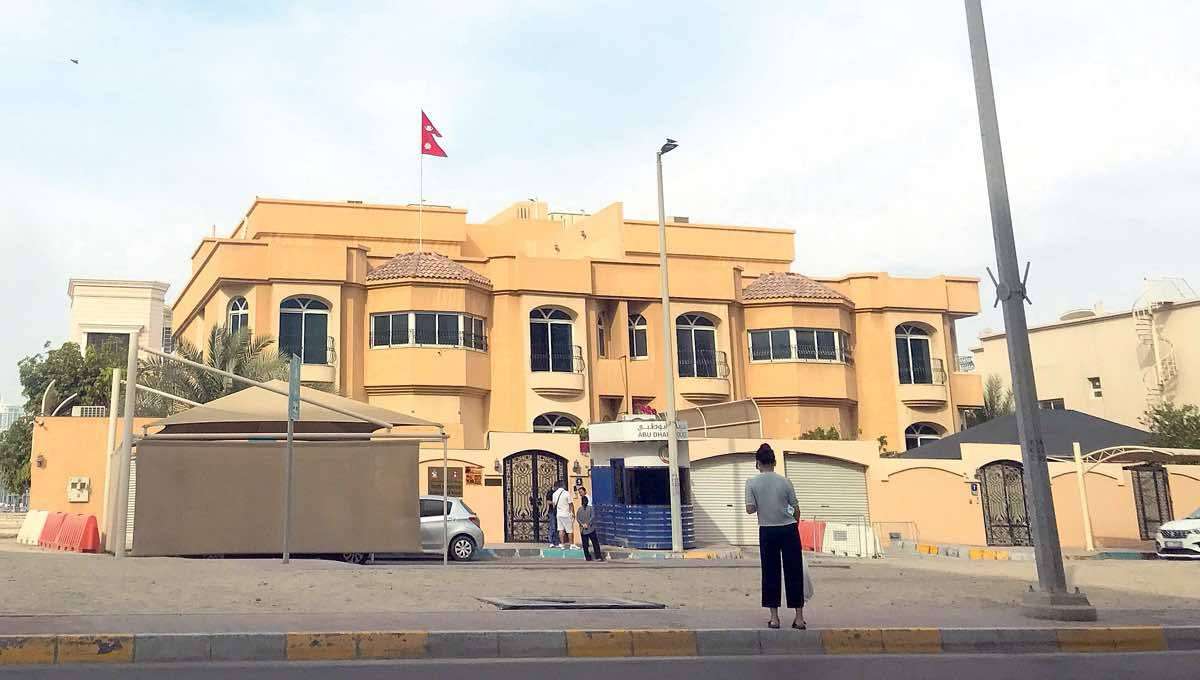
On May 7 (Baisakh 24), within the premises of the Nepali Embassy in Abu Dhabi, a young man from Surkhet with the surname Tomata was visibly distressed, his eyes welling with tears. “I’m doomed,” he cried. “If I don’t get work today, I’ll be overstaying. The police will arrest me and deport me.” He was pleading with his friends when he approached a journalist nearby. Seeing his panic, I couldn’t help but feel uneasy. I asked him gently, “Don’t worry—won’t the embassy try to help you?”
His response was heartbreaking: “How can I not worry? The embassy staff say this isn’t their problem. They tell us to go sleep in the park.”
I was shocked by his reply.
Outside, along the roadside near the embassy, other Nepali workers echoed similar frustrations: “What is there to say about the embassy staff? If we ask anything, they get irritated. They scold us. Who will listen to our problems?”
Hearing the pain and struggles of these workers, I felt compelled to go inside the embassy to learn more. As I entered, I met a staff member on the ground floor. He asked sharply, “Why are you here?”
I replied politely, “Sir, I just have a small issue.”
Before I could say more, he commanded, “Go sit there,” pointing toward the waiting room.
I tried to explain further, “Sir, I needed to meet an official…”
I couldn’t even finish before he snapped, “Go sit over there. Why do you need to meet a superior?”
His attitude left me stunned. Silently, I walked into the waiting room.
Around two dozen workers with various problems were already there. I sat beside Om Bahadur Roka from Rolpa and asked him what brought him there. He explained his situation in detail: his company had canceled his visa but refused to return his passport. Now, in order to return home, he needed either a new passport or travel documents.
The young man had come to the embassy precisely for that reason. I asked, “So, did you get your work done?” He replied, “No, they told me to bring a police report. I don’t even know where or how to get it. If we ask questions, the embassy staff get annoyed.”
Dawa Sherpa from Sankhuwasabha was also frustrated because the Nepali Embassy in Abu Dhabi was uncooperative regarding his issue. He needed a marriage registration certificate, but the embassy told him they don’t handle such procedures and sent him back. “It’s difficult to go back to the village just for such a minor issue. If it could have been done here, it would’ve been so much easier,” he said.
Workers stated that each visit to the embassy costs them around 200 dirhams (approximately 7,200 Nepali rupees). Despite such expenses, when their work remains incomplete, frustration grows. Roshan Bhandari from Sarlahi was anxious because his passport was about to expire, but he hadn’t been able to fill out the renewal form. “The form opened online yesterday, and when I asked about it, the staff scolded me,” he said. “How are we workers supposed to know exactly when the form opens? I came all the way from Dubai, and even after reaching here, my work still didn’t get done. Where are we supposed to go now?”
Other workers claimed that the application forms are also released in a “managed setting.” One worker nearby showed a Facebook status as an example, which was posted by journalist Janak Khadka, active in Dubai. In the post, Khadka demanded the resignation of NRNA UAE president Bikash Shahi, alleging that Shahi had placed one of his employees as a “volunteer staff” at the embassy, who had access to all official information and used it to benefit Shahi’s private business.
The Gulf nation of the United Arab Emirates (UAE) has become a major destination for Nepali workers, with estimates suggesting over 600,000 Nepalis are employed there. They face problems such as lost passports, visa expiration, company abandonment, overstaying, and arrests due to alcohol consumption. However, instead of providing support and solutions, embassy staff are often accused of scolding and being rude to service seekers.
Due to lack of timely support, some overstaying workers have even been found sleeping on the roadside in front of the embassy.
When asked why embassy staff behave rudely and scold workers, Ranjita Dahal, the consular and spokesperson for the Nepali Embassy, responded, “Do you even know who you’re speaking to? Be careful when you talk.” She insisted that despite limited resources, the embassy is doing its best to serve Nepali workers. “If any staff behaved rudely or got angry, that’s wrong,” she admitted. “But clients must also respect the staff, and we too offer them respect.”
Dahal stated that there are currently between 700,000 to 800,000 Nepalis working in the UAE. “We are understaffed, and we have to serve up to 500 people a day,” she said. “That’s why we use volunteer help from NRNA and the Nepali community. But volunteers do not have access to embassy data.”
A former NRNA UAE official said, “Because of one journalist’s Facebook post, the previous ambassador had him jailed for six months. There’s now a widespread fear that arguing with embassy staff could land someone in jail. That’s why many staff act with arrogance.”
Service seekers also complained that the embassy has long used lack of manpower as an excuse, even in cases where people haven’t received blood money (compensation for death) or insurance for years. Currently, 24 people are still waiting for blood money, and over 160 are awaiting insurance payments. Many of these cases are between one to five years old.
In the UAE, when a Nepali dies due to an accident or other causes, the law stipulates that families are eligible to receive 200,000 dirhams (approximately NPR 7.8 million) in compensation.
If each family were to receive this amount, then a total of approximately NPR 190 million in compensation is still pending. If we include the 160 insurance claims, the total estimated unpaid amount exceeds NPR 500 million. However, due to negligence and delay on the part of the embassy, service seekers claim they have not received the compensation.
From: Esancharpati