Kathmandu, April 14: The lush green forests of the enchanting environment are teeming with people. With the dawn of the New Year, the crowd of people is increasing in the natural area of Shivapuri Nagarjuna National Park.
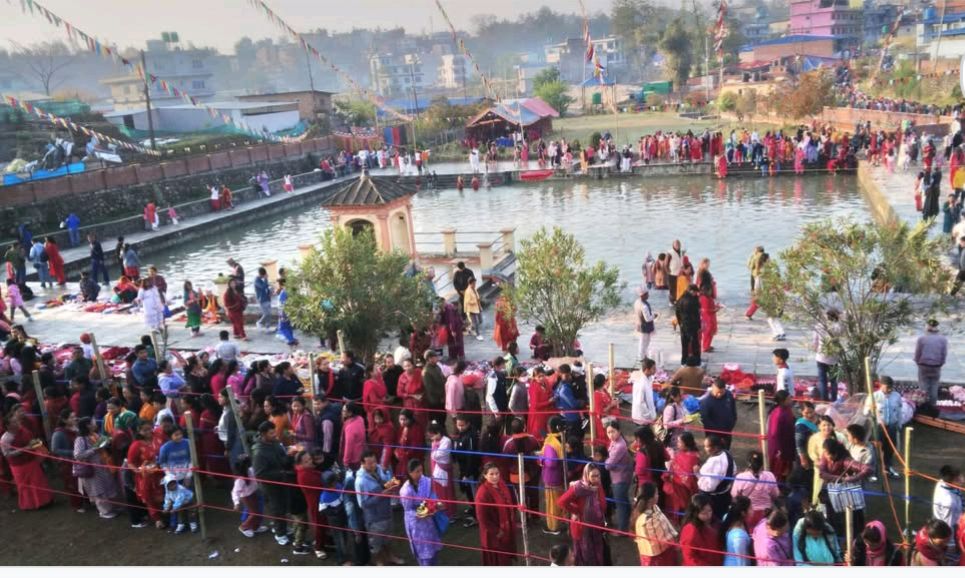
Every year, on April 1st, a bathing fair is held in Bagdwar, the source of the Bagmati River, located in the middle of this park. A crowd of devotees has been heading towards the park since this morning to celebrate the fair. Some devotees had reached here in mid-Chaitum to stay overnight. Devotees who had reached here on Sunday evening are seen bathing in the morning and returning. The Sundarijal area has become a fair with devotees coming and going to Bagdwar on April 1st. It is said that a similar scene was seen in the Budhanilkantha area as well.
People have flocked to celebrate the New Year in a quiet and picturesque place near the hustle and bustle of the capital. Five years ago, the Gokarneshwor Municipality had organized the festival to promote Bagdwar and its gateway, Sundarijal, with the aim of promoting tourism.
Similarly, Budhanilkantha Municipality also organizes such programs from time to time. Through which the Bagdwar area, the headwaters of the Bagmati River, is promoted. Bagdwar, located within the Shivapuri Nagarjuna National Park on the border of Kathmandu and Nuwakot districts and Gokarneshwor and Budhanilkantha municipalities, is considered a holy pilgrimage site for bathing on New Year’s Day.
There is a religious belief that if you come here today and take a bath, your sins will be washed away and you will attain eternal virtue. There is also a religious belief that if you take a bath in the Bagmati on the day of Vaishakh Sankranti, when the Sun enters Aries from Pisces, your wish will be fulfilled.
Since the month of Baisakh and the Bagmati River are related, there is a statute to conduct the Bagmati pilgrimage from Chobhar to Bagdwar since ancient times. This pilgrimage, which has been extinct since 2030 BS, has been continued by the Pashupati Area Development Trust since 2075 BS. The Bagmati pilgrimage, which was held for two years, 2075 and 2076 BS, was postponed for the next few years due to the Corona epidemic. Even after the Corona epidemic subsided, the pilgrimage has not been able to take place due to the health of the priest of the agamghar who conducts the pilgrimage. The trust has stated that it is not certain whether the Bagmati pilgrimage will be held this year as well.
The story of the origin of Bagmati, the source of civilization in the valley
There are various legends about the origin of Baghdwar. At the beginning of creation, Brahmaji was sitting in the middle of Mrigendra peak while doing penance and there was a shortage of water. Brahmaji meditated on Shivaji and manifested through Shivaji’s voice, hence the name Bagmati, says Prof. Dr. Rishiram Pokharel, who has studied the Vedas and is explained in religious texts including Nepal Mahatmya’s Himavatkhand.
“It is described in religious texts that when Brahmaji was doing penance for Shivaji, all the gods came and gathered here. Since the Bagmati river appeared from Shivaji’s speech during this assembly, this river is called Brahmi, Saraswati, Bharati, Bagmati, and Bagmati,” he said.
After the appearance of the Bagmati, Lord Shiva granted a boon that even if one bathes in this river, one will get the same results as performing the Ashwamedha Yagya, attaining Bhukti and liberation, hence the religious belief that the bathing fair is still held. It is believed that drinking the water from the Mrigendra peak, where the Bagmati River appears, will purify the speech of those who have a speech impediment. Due to this belief, thousands of people reach Bagdwar on the 1st of Baisakh to bathe and drink water.
Shriram Sapkota, former associate professor at Valmiki Vidyapeeth, says that the tradition of bathing in the Bagmati and making donations during festivals such as solar eclipses, lunar eclipses, and Aunsi has been going on since ancient times, as Lord Vishnu granted a boon that every place where the Bagmati river merges with other rivers will become a pilgrimage site and that bathing and donating here will bring merit.
The Bagmati River is continuously known as the Bagmati River until it joins the Jamuna River in India, and in the meantime, one thousand and eight pilgrimage sites have been built. The Bagmati River is also important because fairs are held at each of these pilgrimage sites from time to time.
In ancient times, the Shivpuri region, which was considered a perfect place for penance, meditation, and spiritual practice, has been mentioned in various scriptures as evidence that sages including Agastya, Dadhichi, and Kartikeya came to this region for penance. In the modern era, Shivpuri Baba became world famous after coming to this region for penance.
The place where Shiva and Parvati performed penance while Shiva was wandering in this area, fascinated by the Sundarijal waterfall, is still famous as Shailmateshwar and Parvati, meaning Sundarimai. Locals believe that Sundarijal was named after both of them since ancient times, says Sushil Simkhada, a local.
Bishnu Prasad Dhital of Tarakeshwor, who comes to bathe in Bagdwar every year on Baisakh 1, says that he goes to bathe because he feels happy and feels good about himself after walking for three hours on a forest path, even if it is only once a year.
Bagdwar Kshetra Seva Samiti Chairman Arun Thakuri says that there is a ritual of bathing at the source of Bagmati and worshipping the 35-meter-high Shat Rudreshwar Shila on Shivpuri Hill. There is a ritual for the devotees to bathe at Bishnu Dwar and then worship at Bishnu Paduka. It is believed that if they do this, the devotees’ wishes will be fulfilled.
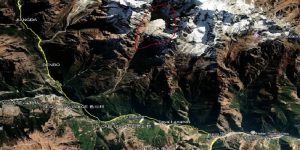
Bagdwar can be reached from two places, Budhanilkantha and Sundarijal. After a three-hour scenic journey through the Shivapuri Nagarjuna National Park from Budhanilkantha and three and a half to four hours from Sundarijal, one reaches Bagdwar, which is full of natural shade and beauty. There is a legend among the people of the valley that if one takes a bath in Bagdwar and Sapanatirtha on Baisakh 1 and watches the Bisket Jatra in Bhaktapur, one will not get sick for a whole year.