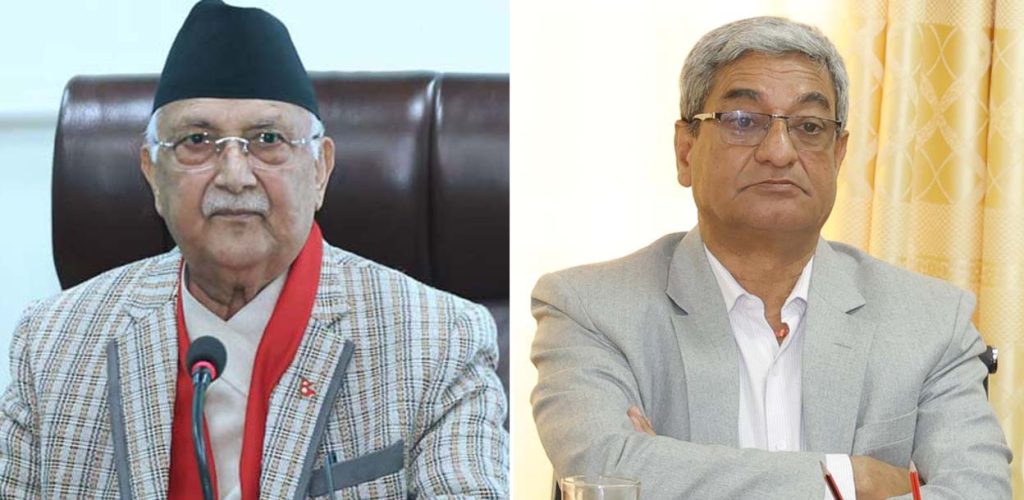
Kathmandu, 7 April: The Supreme Court on Monday night ordered that the investigation against former Prime Minister KP Sharma Oli and then Home Minister Ramesh Lekhak be completed by 26 Chaitra (coming Thursday).
The Court stated that if the investigation is not completed by Thursday, they must be released under certain conditions. At the same time, the Supreme Court deemed their detention lawful and refused to issue a habeas corpus order.
In the order issued by the bench of Justices Binod Sharma and Sunil Kumar Pokharel, it is stated: “If the investigation is completed within the time frame set by the Kathmandu District Court on 22 Chaitra and a decision is made on whether to file a case or not, it should proceed accordingly. If not, after the expiry of the extended detention period, KP Sharma Oli and Ramesh Lekhak should be released from custody, and further investigation and necessary actions should be carried out.”
The Supreme Court has instructed that their release must follow Section 15 of the National Criminal Procedure Code, 2017. This provision allows the investigating officer to release a person in custody.
According to the order, the investigating officer may release the detainees with or without the consent of the government attorney. During this process, they may take bail or surety from Oli and Lekhak or release them under the responsibility of another person. These decisions fall under the discretion of the investigating officer.
Four Reasons for the Release Order
The Supreme Court listed four reasons for directing that no further extension of custody be sought from the District Court:
First, statements from both Oli and Lekhak have already been recorded by the police in the presence of a government attorney.
Second, the case of then Chief District Officer of Kathmandu, Chhabi Rijal. He was arrested last Tuesday (17 Chaitra) and released the same day on a personal guarantee. The Court suggested that a similar process could be applied to Oli and Lekhak.
Third, immediately after the Gen Z protest, former Home Minister Lekhak’s mother passed away, and former Prime Minister Oli had recently completed mourning rituals following his father’s death just days before his arrest. The Court considered their mourning period as a reason not to extend detention.
Additionally, the Court noted that former Prime Minister Oli is seriously ill and under the direct supervision of a specialized medical team, which also justified not extending the detention period.
Based on these four grounds, the Supreme Court instructed that the investigation process be concluded promptly.
Not Considered Illegal
The Supreme Court also reviewed the arrest warrant and subsequent procedures against Oli and Lekhak. It found that the emergency arrest warrant issued by the Kathmandu District Police Office on 14 Chaitra was supported by the court.
However, the Court did not elaborate on the concerns raised earlier by a single bench regarding the validity of the emergency arrest warrant. It concluded that the arrests were not unlawful, citing that the warrant was issued, endorsed by the District Court, and repeatedly extended with court approval.
The order states: “Since the act of keeping the petitioners (Oli and Lekhak) in judicial custody with court-approved extensions during the investigation of a criminal offense cannot be considered contrary to law, their detention is not unlawful as claimed. Therefore, a habeas corpus order cannot be issued.”
Lawyers representing Oli and Lekhak had argued that arrests cannot be made solely based on the report of an investigation commission.
However, the police and government attorneys informed the Supreme Court that the arrests were made not only based on the Karki Commission report but also on a formal complaint filed by Purushottam Khatiwada and others.
The Supreme Court had earlier requested the Karki Commission report to clarify this issue. However, in the four-page brief order issued Monday night, the Court did not comment on the report, the evidence presented, or its limitations.
On 13 Chaitra, the day after the government was formed, police arrested former Prime Minister Oli and former Home Minister Lekhak early in the morning. Shortly after, Oli’s wife Radhika and Lekhak’s wife Yashoda filed habeas corpus petitions in the Supreme Court, claiming their husbands were being held unlawfully.
After hearing both petitions together, the Supreme Court did not issue a habeas corpus order but instead issued a directive order to complete the investigation promptly.