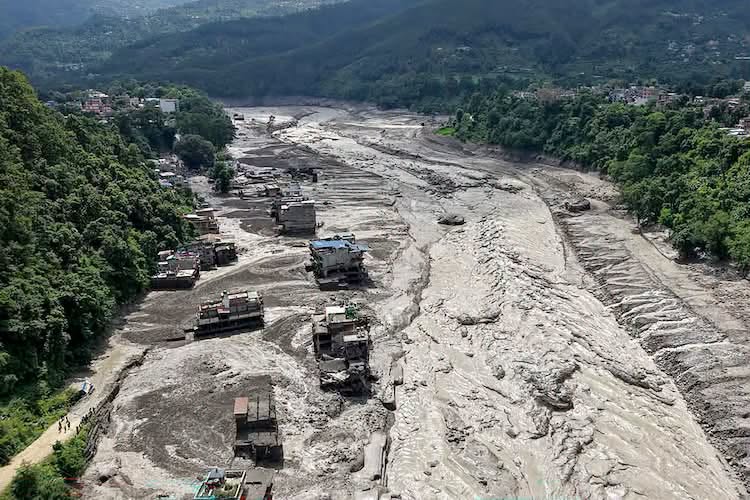
Kathmandu, 27 August: A sudden and devastating flood and landslide in the Bhotekoshi River in Rasuwa on Wednesday morning caused unimaginable loss of life and property. The disaster has affected Rasuwa as well as Nuwakot, Dhading, Gorkha, Tanahun, Chitwan and Nawalparasi East. The bodies of 157 people who died in the floods have been recovered so far. The identities of 15 of the recovered bodies have yet to be established.
According to the Ministry of Home Affairs, 64 bodies have been recovered in Chitwan, 27 in Dhading, 13 in Nuwakot, 19 in Gorkha, nine in Tanahun, three in Rasuwa and 22 in Nawalparasi East. Search and rescue operations are continuing in various locations. Security agencies have estimated that the death toll could rise significantly because a large number of people remain missing or out of contact. Ninety-three people injured in the floods have been rescued and are receiving treatment at various hospitals. All state mechanisms have been mobilized for the rescue operation.
81 Security Personnel Missing
Following the floods, 81 security personnel—including 44 from the Nepali Army, 28 from Nepal Police and nine from the Armed Police Force—are out of contact. Soldiers stationed in Rasuwagadhi, Syafrubesi, Mailung and Betrabati are among those missing. The floods have caused unimaginable damage in these areas. Search and rescue operations are continuing for missing security personnel, tourists, members of the public and employees working in various agencies.
Preliminary reports indicate that the floods have caused extensive damage to settlements, markets, roads, bridges, hydropower projects and structures belonging to security agencies. Sixteen helicopters—seven from the Nepali Army and eight from the private sector, according to the report—have been continuously deployed for search and rescue operations in the affected areas.
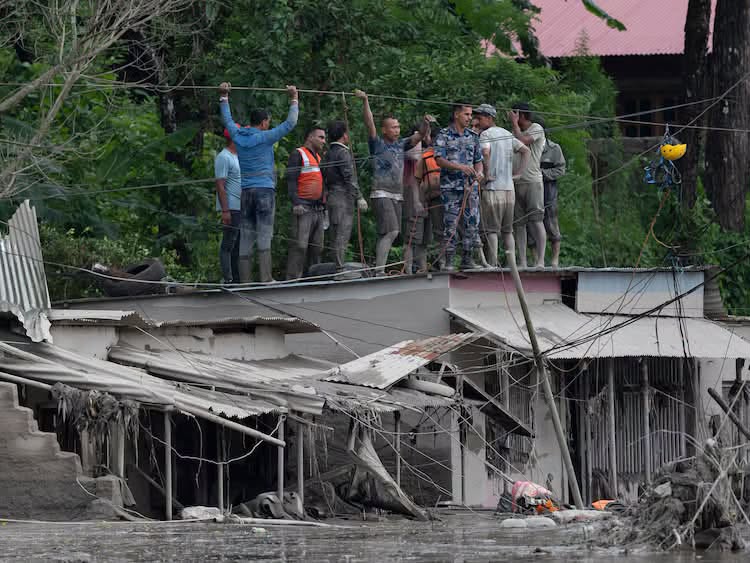
According to Nepali Army spokesperson Brigadier General Rajaram Basnet, 1,700 army personnel, including seven helicopters, have been mobilized for search, rescue, relief and medical operations. The army said it rescued 96 people by air and 26 by land, bringing the total number rescued by the army to 121, who were taken to various hospitals for treatment. Eight private helicopters rescued 29 people.
Nepal Police Central Spokesperson Deputy Inspector General Abinarayan Kafle said the Nepali Army, Nepal Police and Armed Police Force have deployed ground and air resources, drones and K-9 teams with trained search dogs to locate missing people. Houses, shops, roads, bridges and other structures along the riverbanks have been devastated by the floods.
Rapid Action Team Deployed for Rescue
As soon as information about the flooding was received, the Office of the Prime Minister and Council of Ministers activated a Rapid Action Team to make rescue and relief operations more effective. A high-level mechanism was mobilized at the National Disaster Risk Reduction and Management Authority to collect information about conditions in the affected areas and coordinate the response.
Based on the information received, arrangements were made to immediately mobilize security personnel and conduct aerial rescues in coordination with local administrations, elected representatives and security agencies. The Prime Minister’s Office said a study is underway to determine the cause of the unusually severe flooding.
According to preliminary information, the sudden increase in the river’s water level may have been caused by a landslide or avalanche on the Tibetan side that blocked the river and resulted in a sudden release of water. Initial assessments suggest that ice and debris may have blocked the Lende River before water suddenly broke through. However, officials said the actual cause of the flood will be confirmed only after a detailed investigation.
Free Treatment for the Injured
The government has decided to provide free medical treatment to people injured in the floods. A special Cabinet meeting held at the Office of the Prime Minister and Council of Ministers in Singha Durbar on Wednesday decided to arrange free treatment through the Ministry of Health and Food Safety, the Nepali Army and government hospitals, government spokesperson Sasmita Pokhrel said.
Pokhrel, who is also the Minister for Education and Sports, expressed wishes for the speedy recovery of the injured and said the Ministry of Home Affairs and Ministry of Defence would arrange for people to be rescued immediately and moved to safe locations.
“Many people are waiting to be rescued. If a helicopter is needed, they can contact the 1234 hotline. They can also contact the assistant chief district officers in the six other flood-affected districts, share their location and request rescue assistance,” he said. “Those waiting for rescue can light a fire or create smoke to signal helicopters, which will make rescue operations easier.”
Minister Pokhrel said coordination was underway with the governments of China and India for assistance. The Cabinet also decided to immediately provide financial assistance, in accordance with existing laws, to the families of those who died in the floods.
He said people who had lost their homes would be moved to safe locations and provided with food and shelter through the Ministry of Home Affairs, the National Disaster Risk Reduction and Management Authority and the respective disaster management committees.
According to Pokhrel, the Ministry of Infrastructure Development will arrange for the rapid reopening of roads blocked by the disaster and ensure necessary drinking water supplies in the affected areas. The Ministry of Energy, Water Resources and Irrigation and the Nepal Electricity Authority will work to restore electricity services as soon as possible. The Ministry of Information and Communications has been tasked with restoring disrupted telecommunications services immediately.
Pokhrel said the Cabinet had decided to assign the Finance Minister responsibility for coordinating the mobilization of financial resources required for the immediate operation and reconstruction of damaged public structures and physical infrastructure.
Local governments in the disaster-affected districts will also be declared disaster-crisis areas for three months under Section 32 of the Disaster Risk Reduction and Management Act, 2017.
Helicopters Deployed for Search and Rescue
Thirteen helicopters have been deployed to search for and rescue citizens missing in the floods. Foreign Minister Shishir Khanal said 13 helicopters belonging to the Nepali Army and private operators were mobilized.
Addressing the House of Representatives on the disaster, Minister Khanal said Rs 10 million each had been allocated to the disaster funds of Rasuwa and Nuwakot, while Rs 5 million had been allocated to Dhading’s disaster fund to make rescue and relief operations more effective.
He said additional medical personnel from Kathmandu had been sent to District Hospital Nuwakot to treat people injured in the disaster. The hospital received 15 personnel from the Nepali Army, 12 from Nepal Police and 15 from the Armed Police Force. Five hospitals in Kathmandu, including the National Trauma Center and Tribhuvan University Teaching Hospital, have been kept on standby to treat the injured, he said.
Khanal also informed Parliament that security personnel and government employees were among those missing in the floods. He said 26 Nepal Police personnel and nine Armed Police Force personnel stationed in Timure were missing. Similarly, 44 Nepali Army personnel stationed in Timure and Mailung were out of contact. Some employees of the customs and immigration offices were also reported missing.
The floods have caused extensive damage to both government and private structures, Khanal said. Many roads in the affected areas have been damaged, and vehicle movement has also been restricted in the Mugling–Narayanghat area due to safety concerns.
Risk Remains
Authorities have urged residents living along the Bhotekoshi and Trishuli rivers to remain highly alert, as the effects of the flooding could reach downstream areas as well. The risk remains high because water levels could rise further and rivers could become blocked at some locations.
The government has urged people living along riverbanks and in other high-risk areas to move to safer locations. People waiting for rescue have been asked to contact local administrations or security agencies. If telephone communication is not possible, they have been advised to use WhatsApp and other communication platforms to share their location.