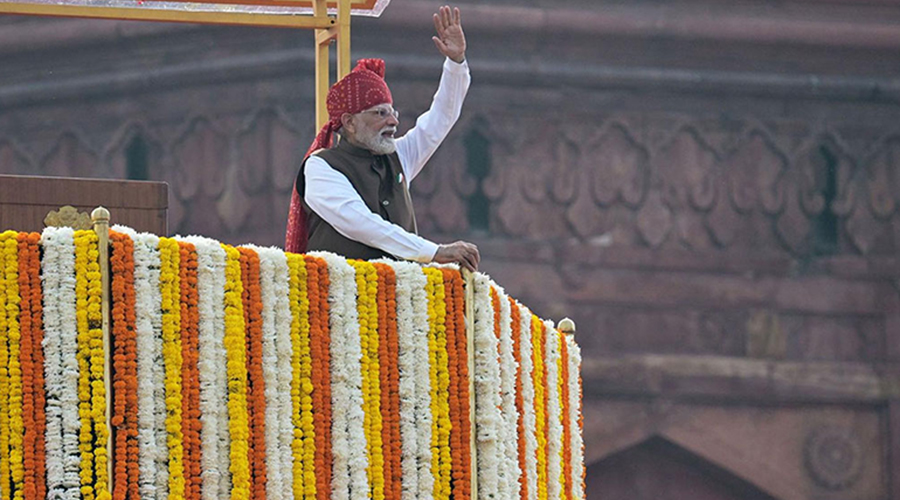
India- On the occasion of India’s 80th Independence Day, Prime Minister Narendra Modi hoisted the national flag from the ramparts of the Red Fort for the 13th consecutive time. In his roughly 75-minute address, Modi highlighted the achievements of his government and announced several new initiatives and policy priorities for the future.
He emphasized increasing manufacturing, defense production and electricity generation. He also announced plans to promote the semiconductor industry and nuclear energy in India. Modi claimed that the country had succeeded in freeing itself from armed Naxalism. He also said that farmers had been provided fertilizers at affordable prices despite a global fertilizer shortage.
From the Red Fort, Modi also announced a new government vision called “Saptadhara” (Seven Streams of Power).
What is ‘Saptadhara’?
Under the concept of “Saptadhara,” Prime Minister Modi outlined seven different forms of power that, according to him, will help India achieve the goals of becoming a “Developed India” and a “Self-Reliant India.”
Modi said, “Today, I also want to remember the era when India’s strength was known, understood and heard as the land of the seven rivers. To build a developed India, we need new streams of strength. Today, from the ramparts of the Red Fort, I call upon the nation to embrace these seven streams of power. In the next five to seven years, we will use their strength and potential to give the country a new height and new momentum and develop the capacity to achieve goals that could not be accomplished in the previous five to seven decades.”
Modi identified manufacturing power as the first stream of Saptadhara. According to him, India should become a reliable hub in the global supply chain, from design to manufacturing. He said India must meet global standards in terms of price, quality and production capacity.
He identified agriculture and food production as the second stream of power. He noted that India had gained access to larger markets through free trade agreements.
Focus on AI and Data Centers
Modi described technology and innovation as the third stream of Saptadhara. Under this initiative, he set goals for India to take a leading position in artificial intelligence (AI), space technology and data centers.
The fourth stream was called “Gati Shakti”, or power of connectivity and infrastructure. Modi outlined plans to connect cities through high-speed rail, build modern highways and expand and modernize ports.
Pointing to the growth of defense production, Modi identified “defense power” as the fifth stream of Saptadhara.
He described the green and blue economies as the sixth stream. He said India should develop world-class capabilities in green hydrogen, renewable energy, energy storage, green transportation and green manufacturing.
He also emphasized the promotion of fisheries and coastal tourism as part of this vision.
India’s ‘Soft Power’ as the Seventh Stream
Modi identified India’s soft power as the seventh and final stream of Saptadhara.
He said India could increase its global influence through handicrafts, culture, films, the creative industries, visual effects (VFX), animation, gaming and digital content creation.
Free Coaching for Students
Against the backdrop of recent student protests and dissatisfaction with the country’s education system, the Modi-led central government has decided to provide free online coaching for competitive examinations.
Speaking from the Red Fort, Modi said the government had decided to launch free online coaching for young people so that competitive examinations would not place an additional financial burden on their families.
“We have digital public infrastructure, excellent talent and teachers. By bringing all these resources together, we are going to build a comprehensive network to provide free coaching to the country’s youth,” Modi said.
From Armed Naxalism to ‘Naxalism of the Mind’
Discussing the government’s strategy against Naxalism, Modi said that Naxalism and Maoism had ruined the future of millions of young people.
Using a new term associated with Naxalism, he said, “The armed Naxalites are gone, but Naxalites of the mind are still looking for opportunities. They are seeking ways to promote violence and disorder. They are making various attempts to pull society in the wrong direction.”
He said such “Naxalites of the mind” must be identified and isolated, while young people should be brought into the mainstream effort to transform India into a developed nation.
Modi has previously used terms such as “urban Naxals” and “Khan Market gang” in his political speeches.
India Bids to Host the 2036 Olympics
The Indian government wants to host the 2036 Olympic Games in Gujarat, and Prime Minister Modi also highlighted the ambition during the 80th Independence Day celebrations.
From the Red Fort, Modi said India was moving forward as a strong contender to host the 2036 Olympics. He also said India would host the Commonwealth Games in 2030.
Modi urged young Indians to participate in sports in which India has traditionally had limited representation. He noted that the Olympics feature around 40 sports and approximately 325 to 350 events, but India currently does not participate in nearly two-thirds of them.
To increase India’s participation in such competitions, Modi announced plans for a nationwide talent-hunt campaign.
Under the initiative, talented children between the ages of 5 and 15 will be identified and provided with specialized training with the aim of developing them into elite athletes.